
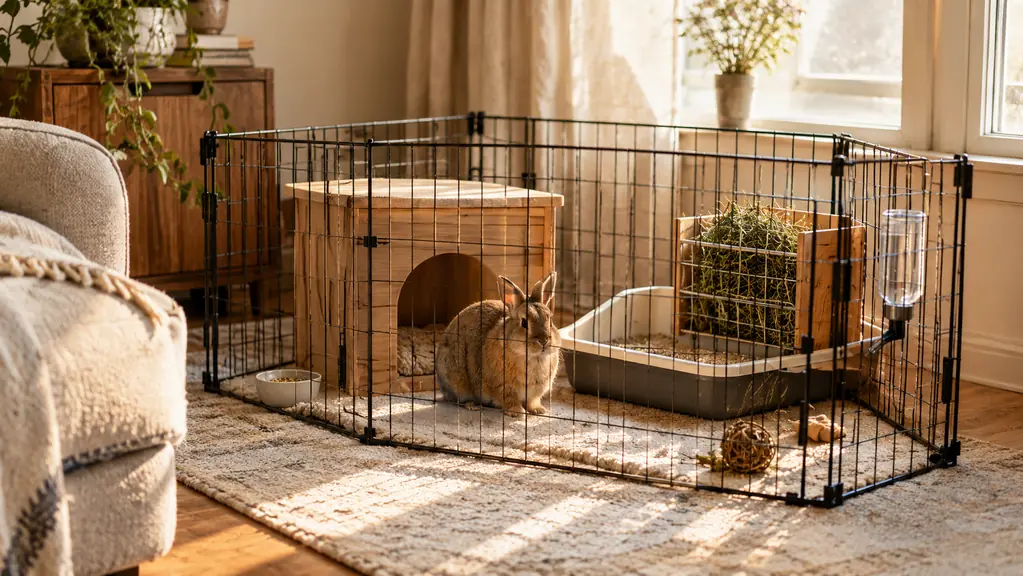
The first week Clover lived here, I found her under the couch more often than in her cage, and I did not blame her. A rabbit built to run, dig, and explore was spending most of the day in a space barely bigger than she was. Rabbits are not meant to sit still, and a bored rabbit will find its own entertainment, usually at the expense of your furniture. I had kept rabbits before, and I knew the answer was more room. What I did not know was how to give her that room without turning my living room into a hazard course.
I tried the obvious things first. Baby gates, which she squeezed under. A cardboard fort, which she ate. Full run of the living room, which lasted until she found the speaker wire behind the TV stand. I looked at a dozen pens online before I settled on this one. What finally worked was the Prevue Small Pet Playpen. Months later, it is still the first thing I recommend to anyone who has just realized a house rabbit needs somewhere safe to run.
The Quick Verdict
The Prevue Small Pet Playpen gives Clover hours of safe run time every day, folds flat when I need the floor back, and has survived her teeth. It is the roomiest, most flexible setup I have used for a house rabbit, and it is the first thing I recommend to new bunny parents.
Amazon Check Today's Price →Give your rabbit a room to run, not just a cage to sit in
The Prevue Small Pet Playpen has given Clover a safe place to sprint and binky for months. If you are tired of chewed baseboards and a bored bunny, check today's price on Amazon and see if it fits your living room. Most owners set it up in one afternoon and never look back.
Amazon Check Today's Price on Amazon →How I've Used It
Clover is a four-year-old Holland Lop, about four pounds, and she lives indoors with me in a small house outside Sacramento. During the day she has the living room. At night, and any time I am not home, she moves into her playpen. That arrangement has been running for months now, and it is the reason I still have baseboards. The pen replaced a smaller cage that was doing nobody any favors.
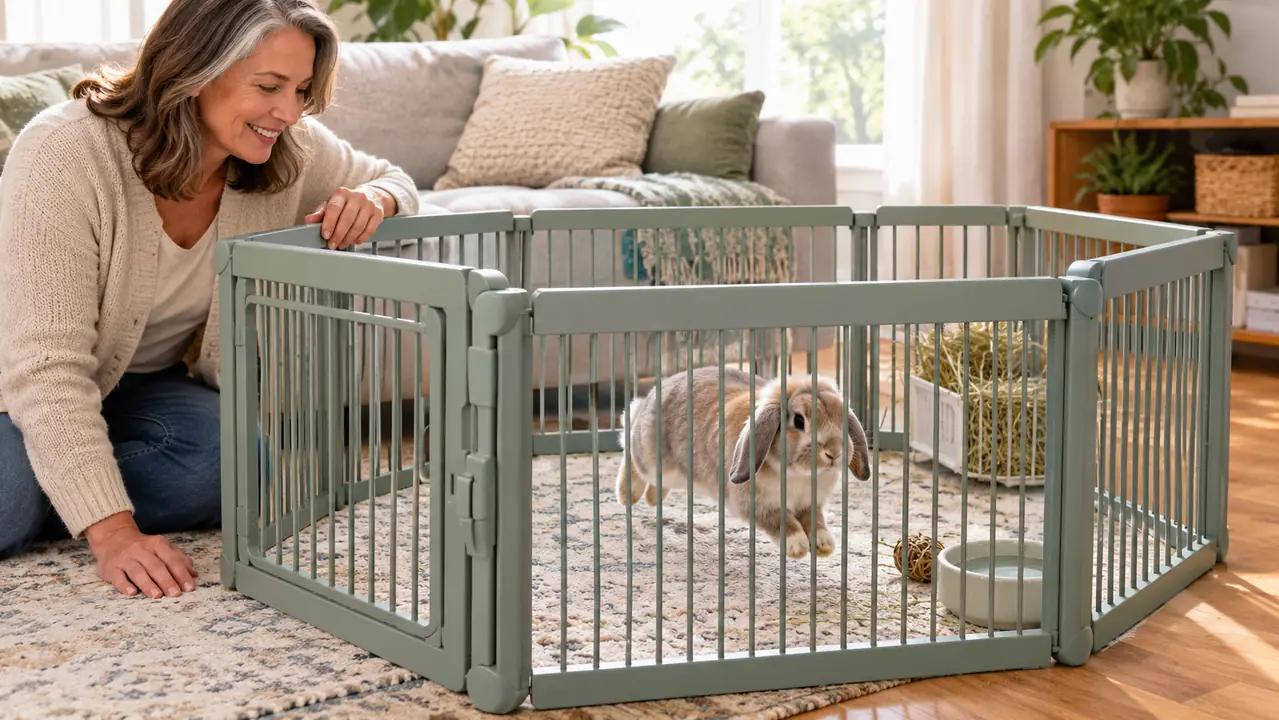
I set the pen up as a long L shape in the corner of the living room, using every panel it came with. Inside she has her litter box, a heavy ceramic water bowl, a cardboard hidey box she is allowed to chew, and a rack of hay. When I open the gate, she runs out for the day. When I close it, she still has a space big enough to sprint a few hops, stretch out flat, and binky without hitting a wall.
Most days she is in the pen for eight or nine hours, mostly overnight and while I am at work. On weekends I often rearrange it into a different shape so the room feels new, which sounds silly until you watch a rabbit investigate a changed pen like it is a brand new place.
The gate is the part Clover figured out fastest. It swings open for me and latches shut behind her, and she has learned that pawing at it does not work, which has not stopped her from trying. I like that I can open a panel from the top without reaching over the whole pen.
Why a Playpen Instead of a Cage or Full Free Roam
A cage gives a rabbit somewhere safe to sleep, but it does not give a rabbit a life. A healthy house rabbit needs room to run, jump, and stretch, and that space should be several times the rabbit's body length in every direction. Clover's cage was fine for overnight, but it was never going to be her whole world.
Full free roam is the other extreme. It is wonderful when you can supervise, and Clover gets plenty of it. But an unsupervised rabbit with a whole house to explore will find the one cord you forgot, the corner of the baseboard that looked tasty, and the gap behind the bookshelf you cannot reach. I have been lucky, but I have also learned to plan for trouble.
A playpen splits the difference. It gives the rabbit a real running space that is bigger than a cage and safer than a whole room. The Prevue does this better than anything I have tried because it is big enough to feel like a room, open enough that Clover can see me, and configurable enough to fit an odd corner instead of forcing me to rearrange my furniture.
I have also noticed the behavior difference. When Clover has room to run, she is calmer, her litter habits stay on track, and she chews the things she is supposed to chew. When she is cramped, she finds trouble. In my experience, a lot of rabbit behavior problems trace back to not enough space.
How Much Room Does It Really Give a Rabbit
The exact floor space depends on how you arrange the panels, and that is the point. In the L shape I use most days, Clover has enough room to take three or four full hops in a straight line, which for a rabbit is the difference between exercise and just existing. Rabbit welfare guidelines call for a space several times the rabbit's length, and this pen clears that with room to spare.
I also like that the space does not have to be a rectangle. Rabbits like options. Clover uses the long side for running, the corner behind her hidey box for napping, and the open middle for binkies. A cage with a fixed footprint cannot offer that variety, and a room with no boundaries offers too much of it.
For a rabbit the size of Clover, the pen is generous. For a larger breed, it would still work, but you would want every panel in a straight run rather than an L. Either way, the point is the same: a rabbit that can move is a healthier, happier rabbit.
How It Holds Up to a Serious Chewer
Clover is a chewer. She has gone through wooden baseboards, cardboard boxes, and at least one phone charger I will not name. So the first question I had about a wire playpen was simple: would she chew through it? Months of daily use later, the answer is that she has not made a dent in the metal, and the only damage to the whole pen is one small tooth mark on a plastic corner connector, which she put there on day two and has not repeated.
The coated wire wipes clean with a damp cloth, which matters more than you might think. Rabbit urine can build up fast if you are not careful, and the open design means I can reach every panel without taking the pen apart. The connectors snap together and hold their shape, though I do give them a press back into place every couple of weeks when I rearrange the setup.
I will be honest about the limits. This is not a chew-proof fortress, and a rabbit that is determined to gnaw on the plastic connectors will eventually do damage. Clover decided early that the cardboard hidey box was a better target, and I made sure she always had something legal to chew. Give a rabbit a choice between a pen panel and a cardboard tunnel, and most will pick the cardboard.
The cleaning routine is simple. Every morning I spot clean the litter box, and once a week I wipe down the panels and the plastic connectors with a damp cloth and a little vinegar water. Because the pen is open on all sides, nothing hides behind a solid wall. I can see every corner of it from the couch.
Setting It Up and Living With It
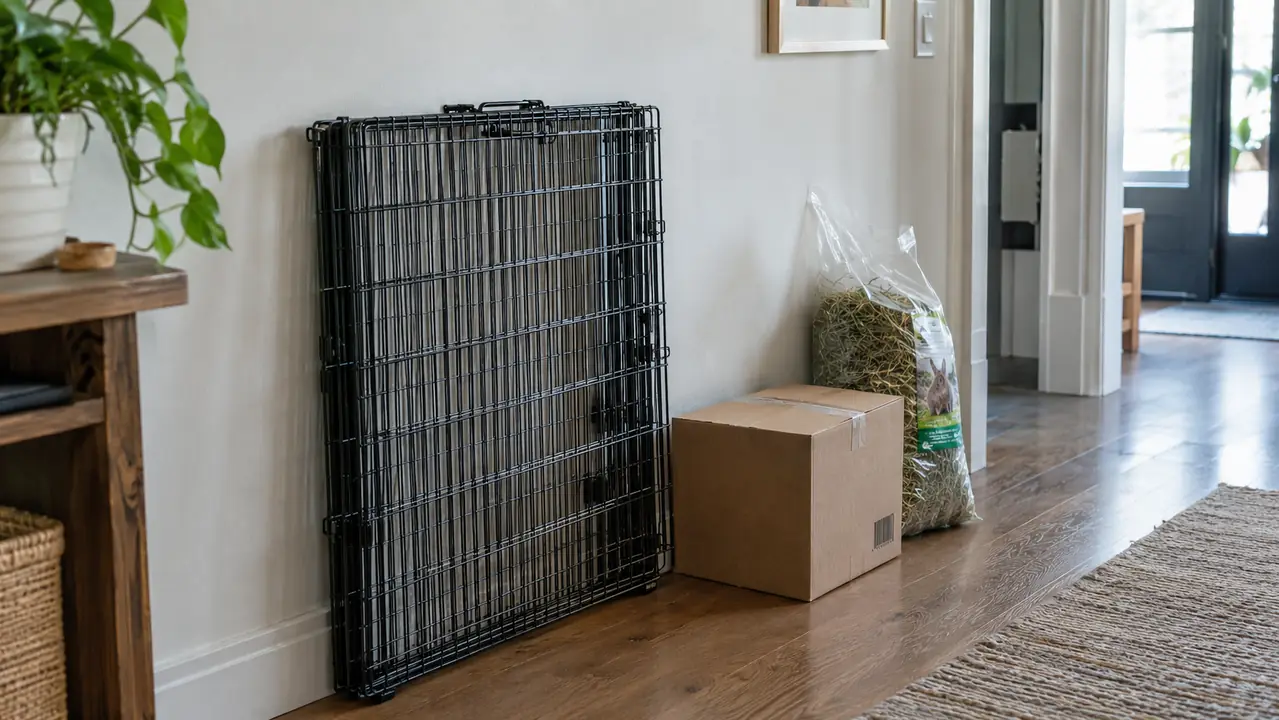
The pen arrived flat in a single box, and nothing about the setup required tools or a second pair of hands. I laid the panels out on the floor, connected them, and stood them up. It took about ten minutes the first time and five minutes the second. When I need the living room floor back, it folds flat and leans against the wall in the hallway.
The shape is the part I did not expect to love. Because the panels connect in a straight line, I can make a square, a rectangle, a long run, or an L shape around a piece of furniture. I have used it as a pen, as a temporary gate across a doorway, and once as a ring around the Christmas tree to keep Clover out of the presents. A fixed cage cannot do any of that.
There are two things to know before you buy. First, the pen has no floor, which is good for a litter-trained rabbit and bad for one that is still learning. Clover has been litter trained for years, so the open bottom lets her sit on the rug. If your rabbit is not there yet, plan to put a waterproof mat underneath. Second, the height is enough for a Holland Lop, but a determined jumper from a bigger breed could clear it. Know your rabbit.
Portability is a bonus I did not plan on. When I needed to move the pen to another room for a few days, it folded flat, leaned against the wall, and set up again in minutes. No tools, no loose parts, no puzzling over which panel goes where. It travels as easily as a folding chair.
Alternatives I Considered
Before I settled on the Prevue, I tried a pop-up playpen a friend lent me. It cost less and folded into a circle, but Clover pushed the walls around and the mesh bottom made a mess of the rug. The Prevue's panels held their shape, and the open bottom let her sit on the rug instead of on fabric I had to wash. If you are trying to decide between those two, [I compared them side by side in a separate article](prevue-playpen-vs-pop-up-rabbit-playpen).
I also looked at dog exercise pens. They are taller and heavier, and they work well for rabbits that jump. But they cost more, fold up bigger, and honestly look like dog gear in a living room. For a four-pound Holland Lop, the Prevue has been plenty, and I have never wished for more height. If you are still wondering whether a playpen is worth the floor space, [I wrote up ten reasons a house rabbit benefits from one](10-reasons-a-playpen-gives-house-rabbits-room-to-run).
The cheapest option I tried was a DIY enclosure made of cardboard boxes taped together. It lasted an afternoon. Clover treated it as a snack and a renovation project all at once. A pen made of real panels costs more up front, but it has lasted years instead of hours, which makes it cheaper in the end.
What I Liked
- Gives a house rabbit a real running space, not just a place to sit
- Panels reconfigure into squares, rectangles, long runs, or L shapes
- Folds flat and stores against a wall in minutes
- Easy to wipe clean and has survived months of a serious chewer
- Open design lets the rabbit see the room, so it does not feel shut away
- Open top makes it easy to reach in from above for a quick check
Where It Falls Short
- No floor included, so a rabbit that is not litter trained needs a mat underneath
- A determined jumper can clear the top, so it is not right for every breed
- Plastic connectors need an occasional press back into place
- It is a pen, not a cage; you still need a litter box and hidey box inside
- It does not replace daily supervised free roam time; Clover still gets the living room when I am home
After six months of daily use, the only damage to the whole pen is one small tooth mark on a corner connector, and Clover put it there on day two.
Who This Is For
This pen is for anyone who has a house rabbit and a floor plan that does not survive full-time free roam. It is for the person who works during the day and wants to come home to intact cords. It is for the owner of a litter-trained rabbit who wants to give the rabbit a bigger world without giving up the whole house. And it is for people with odd corners, because the panels fit around furniture instead of fighting it.
Most of all, it is for rabbits. Clover spends hours in hers every day, and she uses every inch of it. She sprints, she binkies, and she flops flat on her side in the middle of the floor, which is about the highest compliment a rabbit can give a space.
If you are reading this because your rabbit just chewed something expensive, you are in the right place. The pen will not fix the chewing overnight, but it will give you a safe space while you work on it, and it will save your furniture in the meantime.
Who Should Skip It
Skip this pen if your rabbit is still working on litter training. Without a floor, accidents end up on whatever is underneath, and you will spend more time washing rugs than enjoying the pen. Get a waterproof mat first, or wait until the litter habit is solid.
Skip it if you have a larger breed or a known jumper. The height that keeps Clover inside will not stop a determined rabbit that can clear a baby gate. And if your rabbit is a dedicated chewer of plastic, the connectors will eventually tempt it. For everyone else, this has been the most useful piece of rabbit gear in my house, and it is the first thing I recommend to new bunny parents.
One more group should skip it: anyone who wants a set-and-forget cage. This is not that. It is a pen, which means you still set up the litter box, the hay, the water, and the hidey box inside, and you check the connectors now and then. That is a few minutes a day, and for me it is worth it.
The playpen that finally gave Clover room to run
After months of daily use, the Prevue Small Pet Playpen is still the piece of rabbit gear I recommend first. Check today's price on Amazon and see if it fits your living room. It has survived Clover, which is the highest praise I can give any piece of rabbit gear.
Amazon Check Today's Price on Amazon →