
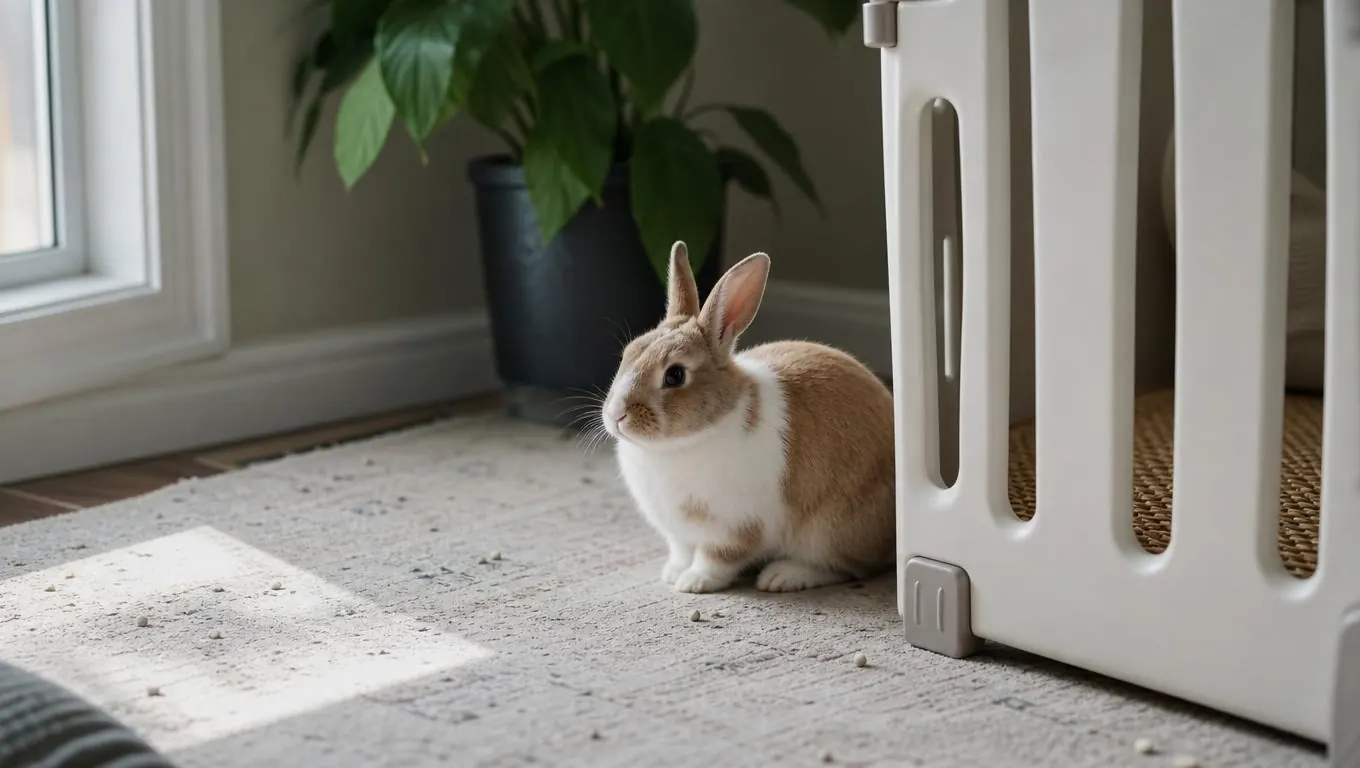
The first thing people ask me when they find out I keep a house rabbit is how I manage the chewed cords. The honest answer is that I do not manage them, I made them impossible. Bunny-proofing a room is not about watching a rabbit more closely. It is about deciding, once, what that rabbit can reach, and then making sure the room agrees with that decision. A Prevue playpen gives you the controlled space, and the steps below give you the room to put it in.
I have kept house rabbits for about fifteen years, and my current rabbit, Clover, is a four-year-old Holland Lop who weighs about four pounds. She has free run of the living room during the day and moves into her pen at night. That arrangement only works because the room was bunny-proofed before she ever got her freedom. Here is the order I use when I set up a new space, and it works for a first-time bunny owner as much as it does for someone who has been at this for a while.
Start with a playpen that actually holds a determined rabbit
Bunny-proofing starts with a secure base. The Prevue small pet playpen gives you a tall, sturdy enclosure you can shape around furniture, doorways, and baseboards. Check today's price on Amazon to see the current options.
Amazon Check Today's Price on Amazon →Step 1: Get Down to Rabbit Level and Look for Trouble
Before you move a single piece of furniture, get on your hands and knees. Rabbits live close to the floor, and the dangers they find are the ones you will never notice standing up. Look for exposed cords, the gap behind the TV stand, the corner where the router sits, the lamp cord that loops within easy reach. Make a list. Do not trust your memory to catch it later, because a rabbit's memory for forbidden objects is better than yours.
The biggest risk by far is electrical cords. A rabbit's teeth will go through a phone charger in seconds, and the result can be a burned mouth, a dead device, or worse. I use cord protectors on everything I cannot unplug, and I unplug the rest. A cheap plastic spiral wrap works, but the hard plastic tubing meant for cable management is better because a determined chewer cannot crush it flat. I learned this the hard way three years ago, when Clover was barely a year old. I left a laptop charger plugged in at floor level while I stepped into the kitchen to make tea. By the time I came back, she had bitten clean through the cable. The charger was dead, and worse, I could not tell whether she had felt a shock. I spent the rest of the afternoon on the phone with the vet, and the charger went in the bin. The next day I bought a roll of split loom tubing and ran every cord in the living room through it, including the ones I was sure she would never touch. It took about an hour, and I have not replaced a single cable since.
Look at baseboards too. Rabbits love the taste of paint and wood, and a bored rabbit will happily redecorate the room for you. You can protect baseboards with clear plastic corner guards, or you can position the playpen so the rabbit's favorite corners are inside the pen where the damage is contained. I do both, because Clover has opinions about architecture.
Step 2: Set Up the Playpen as a Room, Not a Cage
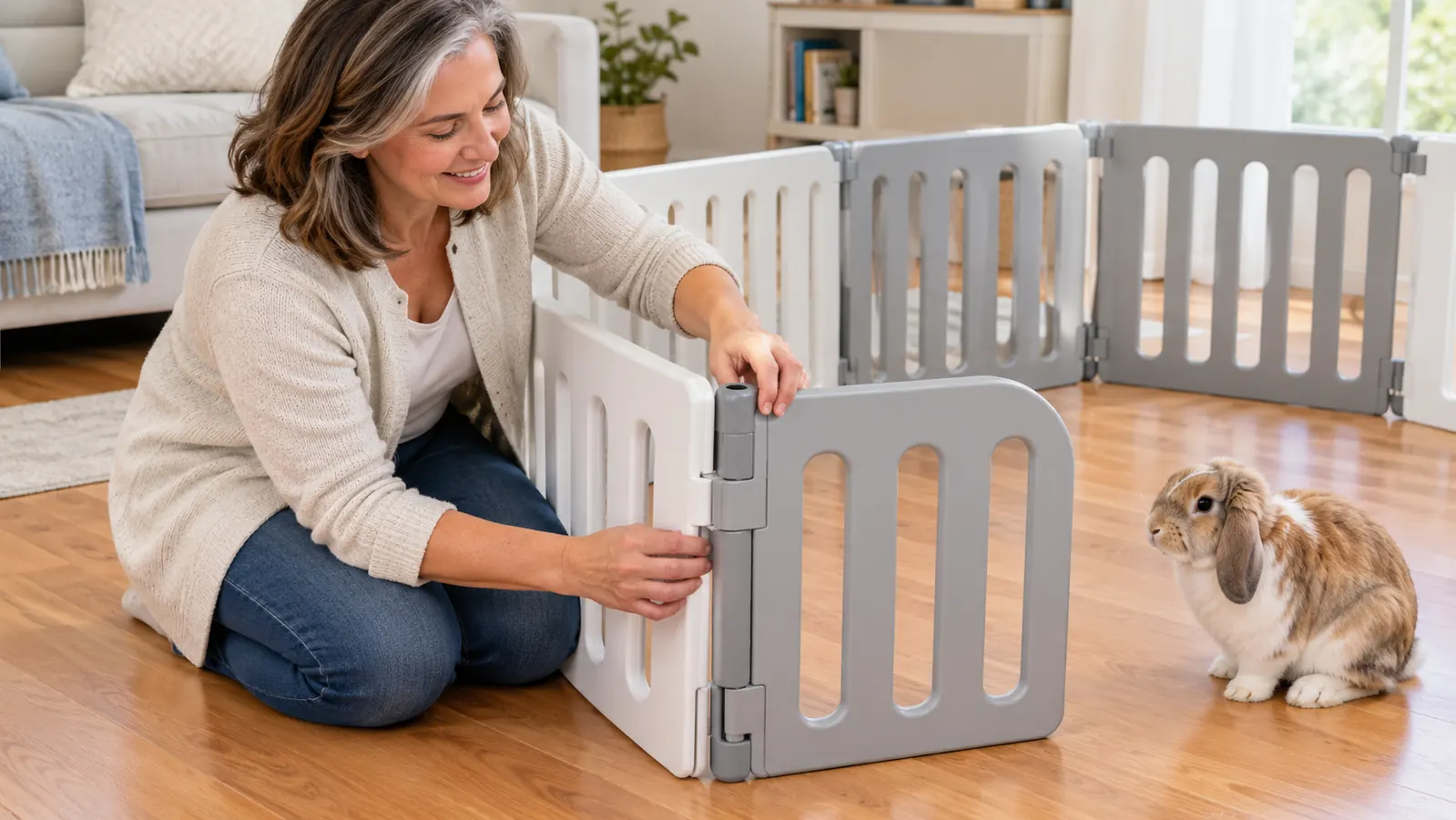
The Prevue playpen is the backbone of my setup because it is less a cage and more a movable wall. The panels are tall enough that Clover cannot jump them, and they connect firmly so she cannot squeeze between the joints. I use it to block off the areas I cannot fully proof, like the hallway with the router and the corner behind the sofa where the speaker cables live. The panel count matters too. I have six panels up right now, four across the hallway and two folded against the wall, and it took me an afternoon to learn that the pen is only as strong as its weakest connection. The first time I set it up, I left one connector loose, and Clover pushed her nose into the gap until a panel popped open. She was through it and into the hallway before I could stand up. Now I check every joint before I walk away, and I have not had a breakout since.
Think of the pen as a way to divide the room into two zones: a safe zone where the rabbit has freedom, and a no-go zone where the hazards stay. You can arrange the panels in a straight line to block a doorway, or fold them into a large enclosure that gives the rabbit a whole corner of the room. The panels are freestanding, so you can reshape the space as your rabbit earns more trust.
One tip from years of trial and error: put the pen up a few days before you let the rabbit explore the full room. Let her get used to the new panels, the new sight lines, and the new rules. Rabbits are creatures of habit, and a sudden change to their territory is stressful. Slow introductions mean fewer surprises for both of you.
Step 3: Remove or Protect Everything Chewable Within Reach
Once the pen is up, walk the room again with fresh eyes. Look at everything at rabbit height: books, shoes, remote controls, plant leaves, cardboard boxes, the corner of the rug, the edge of the coffee table. A rabbit does not chew to be naughty. Chewing is what a rabbit does. It keeps their teeth healthy and it is as natural to them as breathing, so the job is not to stop the chewing, it is to point it at the right things.
Give the rabbit better options than your furniture. A good setup includes a hay rack or a pile of loose hay, a few untreated apple or willow sticks, and a cardboard box with a hole cut in it. Rabbits love to rearrange cardboard, and a box that is theirs will usually win over a box that is yours. I keep a rotating pile of safe chews in the room so Clover never has to look far for something that is allowed.
If you have houseplants, check them against the rabbit-safe list before they go in the room. Many common houseplants are toxic to rabbits, and a curious bunny will sample anything green. Either move the plants to a shelf the rabbit cannot reach or put them in the blocked-off zone behind the playpen. It is not worth the emergency vet visit to find out.
Step 4: Set Up a Litter Corner Inside the Pen
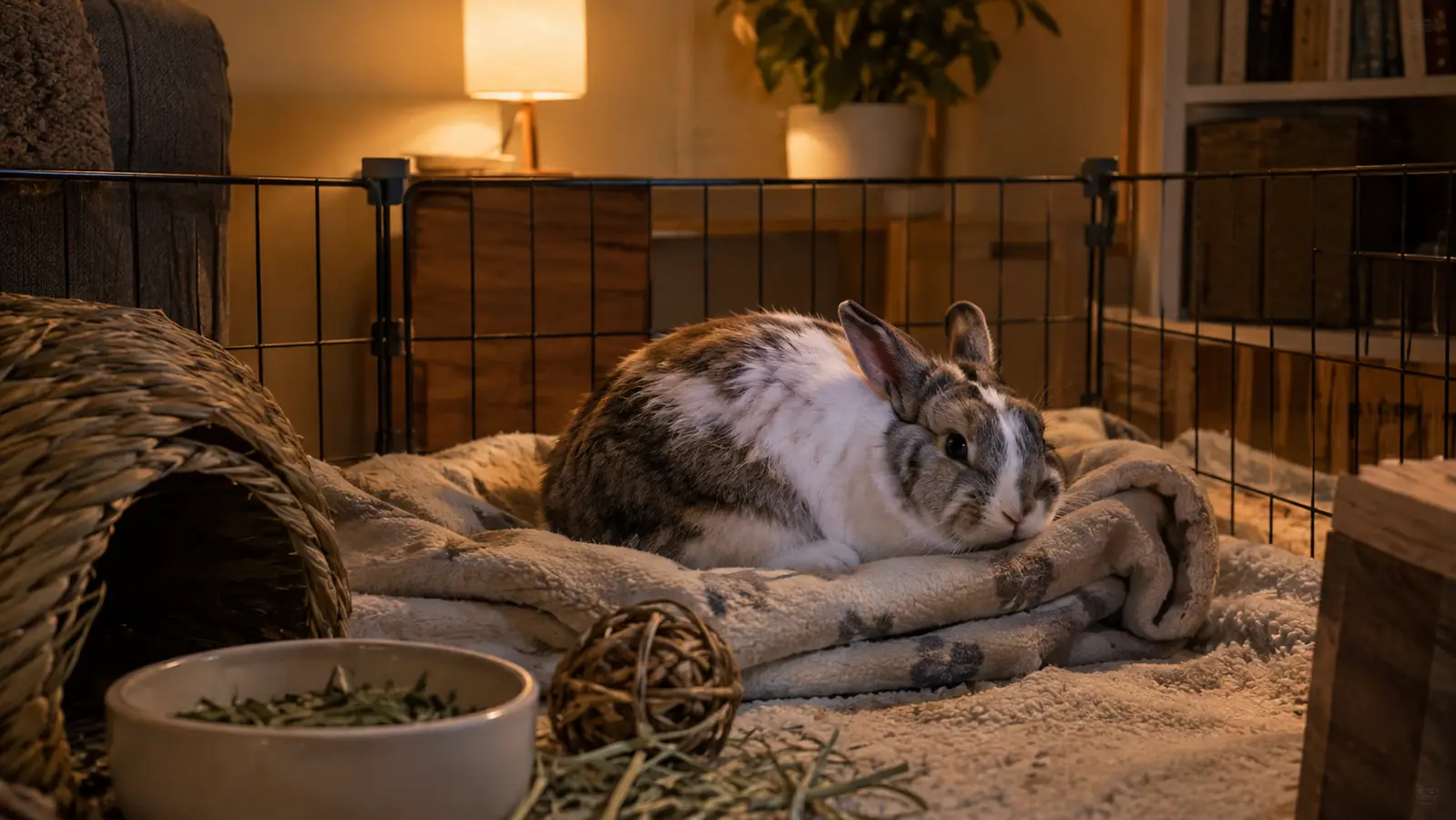
A bunny-proofed room is also a litter-trained room. Rabbits are naturally tidy animals, and most of them will pick a corner and stick to it if you give them the right setup. I put a litter box in the corner of the pen with a layer of paper-based litter and a pile of hay right next to it. Rabbits like to eat and eliminate at the same time, so the hay pile does double duty as a lure and a comfort.
When Clover first came home, I kept the litter box in the pen and let her learn the routine before she had the run of the living room. That sequence matters. If you give a rabbit the whole room before the litter habit is solid, you will be cleaning up after her for months. The pen gives you a small, manageable space where the right behavior is the easy behavior. I also learned quickly that the box itself has to be big enough. My first one was barely bigger than Clover, and she used it, but she missed as often as she hit because she could not turn around inside it. Every miss meant another corner to scrub. I swapped it for a larger pan meant for a cat, and the misses stopped within a day. That is the advantage of doing this inside the pen: the small space showed me exactly where she was going wrong, and I could fix it before she had the whole room to make mistakes in.
Clean the box daily and change the litter every few days. A clean box is a box a rabbit will actually use. If she starts leaving droppings outside the pen, it is usually a sign that the box is full, the hay is stale, or the corner she picked feels unsafe. Fix those three things before you assume the training failed.
Step 5: Give Her Time to Earn the Full Room
The last step is the slowest and the most important. Start with the rabbit in the pen with the door open, and let her come out on her own terms. Stay in the room, sit on the floor, and let her explore while you watch. The first few sessions should be short, fifteen or twenty minutes, and always supervised. You are not just testing the room, you are testing the rabbit's judgment, and that takes time. The first time I opened Clover's pen door, she did not move for a full five minutes. She sat at the threshold, ears up, sniffing the air like the living room was a new country. I sat on the floor a few feet away and pretended to read, and eventually she took one hop out, then another, then a full lap around the coffee table before darting back in. That is the pattern you are looking for: out a little, back to safety, out a little further. I repeated that for about a week, letting her set the pace, and she never once bolted for a cord, because she was exploring on her own terms instead of in a panic.
Every time you catch her heading for a cord or a baseboard corner, say a firm little noise and redirect her to a safe chew. Rabbits learn fast when the lesson is consistent. Over a few weeks, Clover went from needing constant supervision to having a reliable routine, and now she free roams the living room during the day while I work. The pen is still there for nights and for the days when I cannot watch her.
Keep the pen up even after she earns the room. It is not a punishment, it is a safe retreat. Rabbits like having a space that is clearly theirs, and Clover will hop into her pen on her own when she wants quiet. The room stays proofed, the pen stays available, and the rabbit stays out of trouble.
What Else Helps
Beyond the playpen and the cord protectors, a few extras make a bunny-proofed room much easier to live with. A large rug or a set of washable mats protects the floor and gives the rabbit traction, because rabbits can slip on bare wood floors. A hay feeder attached to the side of the pen keeps the hay off the floor and cuts down on waste. A water bowl or bottle that attaches to the pen keeps the water from getting knocked over.
A cardboard castle or a couple of tunnels gives the rabbit somewhere to hide, and a hiding spot is not a luxury, it is a need. Rabbits are prey animals, and a room with no cover feels dangerous to them. A box with two exits is perfect, because rabbits like to know they can escape. And if you have kids or other pets in the house, teach them the same rule I teach everyone who visits: the rabbit's room is the rabbit's room.
The goal is not to watch a rabbit more closely. It is to make the room safe enough that you do not have to watch her at all.
Bunny-proof once, enjoy the room for years
The Prevue small pet playpen is the piece that makes the whole system work. It is sturdy, easy to reshape, and tall enough for a determined little jumper. Check today's price on Amazon to see if it fits your setup.
Amazon Check Today's Price on Amazon →