
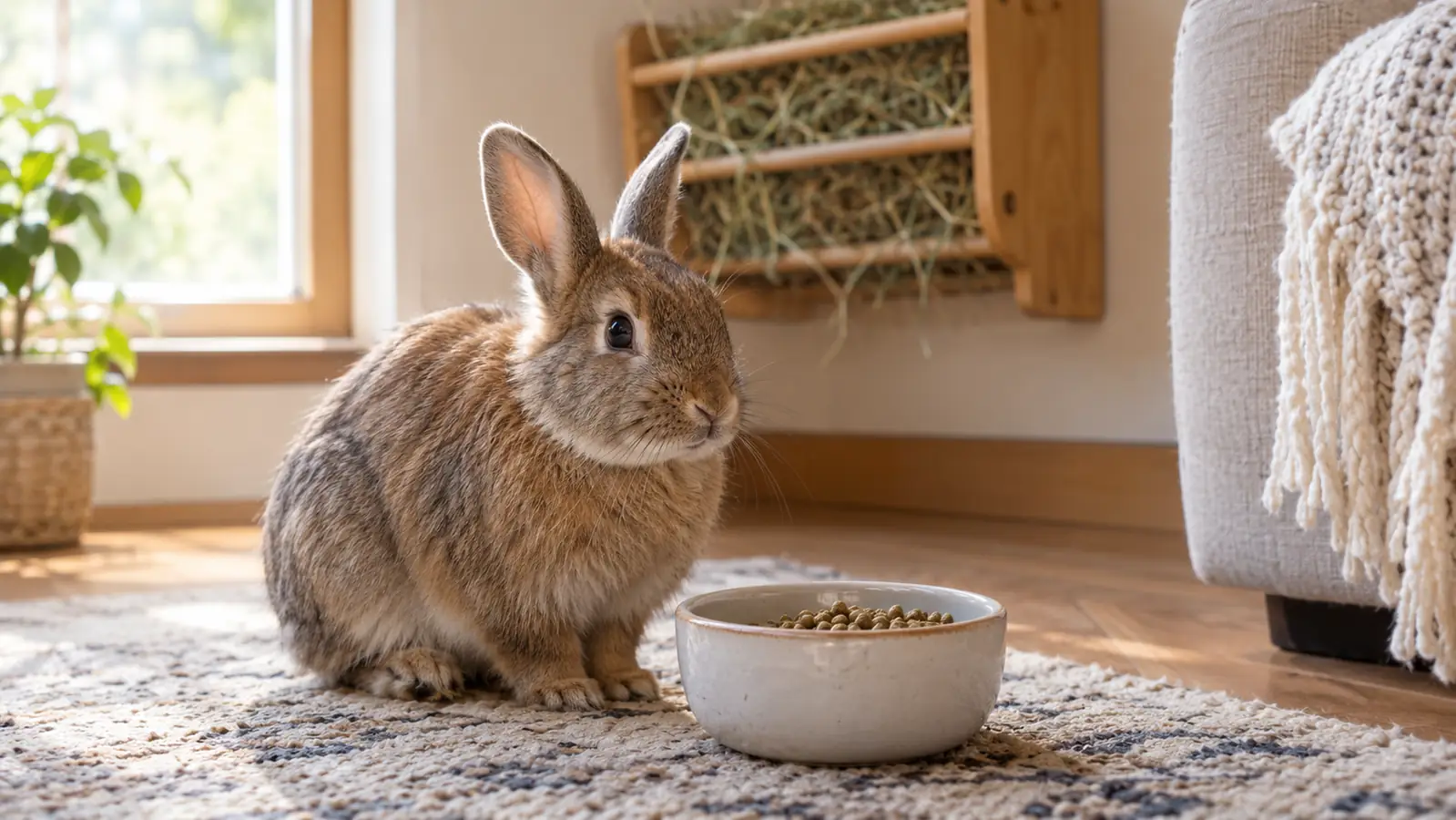
When I brought Clover home four years ago, I did what most new rabbit owners do. I walked into the pet store, grabbed the first bag of rabbit food with a cartoon bunny on the front, and assumed the feeding part was handled. The cashier even nodded approvingly. Nobody told me that the cheerful mix in that bag was the rabbit version of a cereal aisle, or that the serving size I was about to pour would feed three rabbits. Clover, a four-pound Holland Lop with strong opinions, certainly was not going to tell me.
That is the part nobody tells you about feeding a house rabbit. The food aisle is full of options that look like dessert, and your rabbit will absolutely let you know it wants them. Oxbow Essentials Adult Rabbit Food is the opposite of that. It is a plain, uniform, timothy-based pellet with no colorful pieces, no seeds, no dried fruit. It is also, after a year of feeding it to a picky eater who once tipped her bowl over in protest, the bag I keep buying on purpose.
The Quick Verdict
A boring-looking pellet that does exactly what a pellet should do. Clover eats every piece, her weight stays steady, and the quality has not wavered in a year. The transition took patience and the bag has some dust at the bottom, but I would not switch back.
Amazon Check Today's Price →The pellet I landed on after a year of trial and error
If you are looking for a timothy-based pellet for an adult house rabbit, this is the bag I keep buying. It is not exciting, and that is exactly why it works.
Amazon Check Today's Price on Amazon →How I've Used It
Clover is four years old, about four pounds, and she treats her food bowl like a restaurant she reviews nightly. She free roams the living room, sleeps in a pen at night, and has a hay feeder she would happily defend with her life. When I first switched her from the grocery store mix to Oxbow, she made her opinion clear by tipping the bowl over and staring at me with what I can only describe as disappointment.
I did not switch her overnight. I spent about ten days mixing the old food with the new, starting at roughly a quarter new and working up. Even then, she picked around the Oxbow pellets for the first week. Rabbits are creatures of habit, and this one is pickier than most. What finally worked was being stubborn right back. I stopped topping up the old mix and let her finish what was in the bowl.
Now she gets one measured serving in the evening, plus unlimited timothy hay and a small pile of leafy greens. That balance works for us. The pellets anchor the meal, the hay is the main course, and the greens are the part she would eat all day if I let her. For a rabbit her size, the daily pellet serving is surprisingly small, which took me a while to accept.
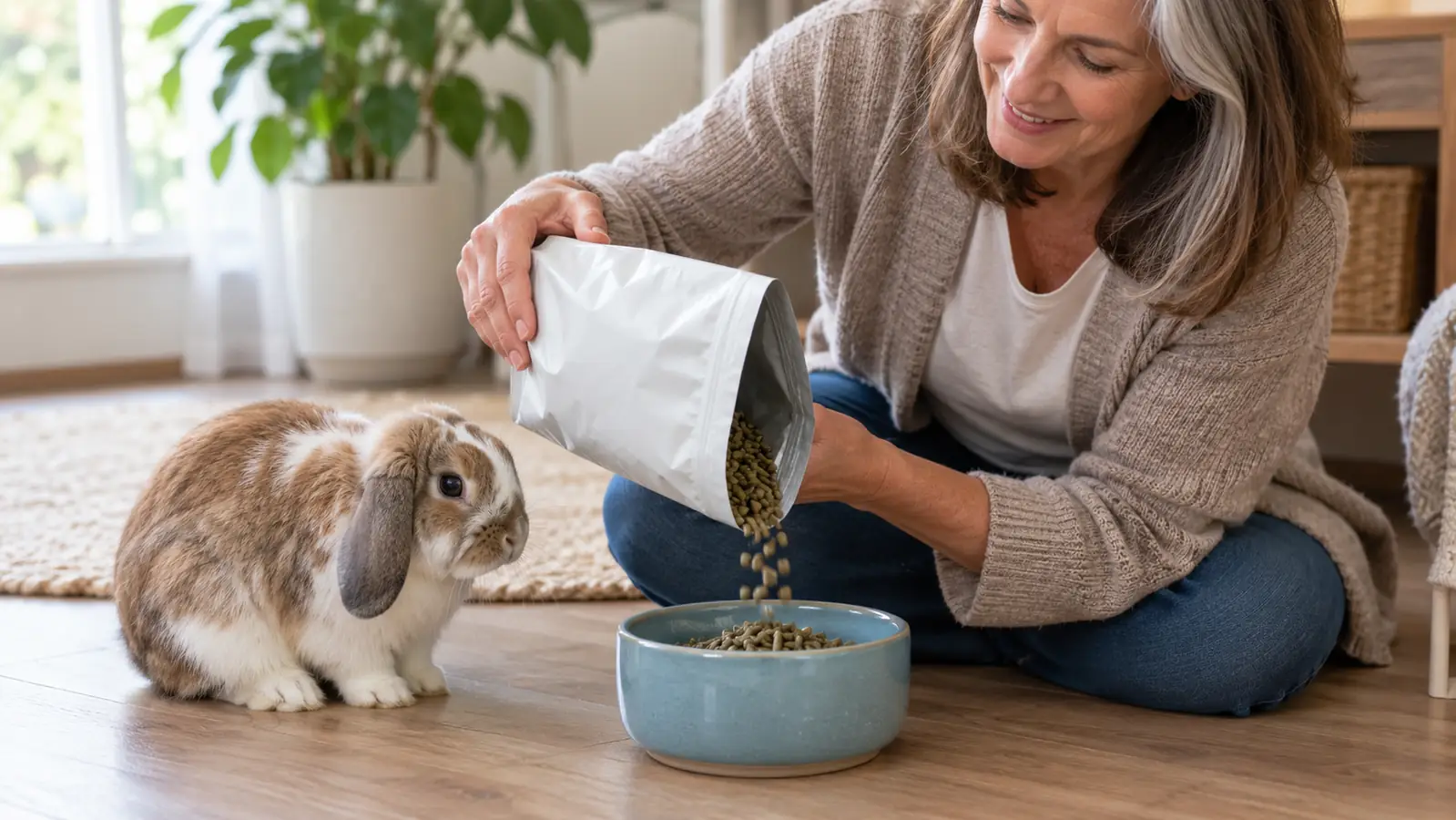
On a normal evening, I fill her bowl with one small measured scoop, then top up the hay rack before I sit down. She eats the pellets first, then moves to the hay, then flops over by the window. The nights I was late with dinner, she sat by her bowl and thumped her back foot. That is how I learned the routine matters more than the brand. A picky rabbit will forgive a lot for a schedule.
What Nobody Tells You Before You Buy
Here is the honest part. Oxbow Essentials is not exciting. The pellets are uniform, plain, and smell like a hay bale rather than a fruit cup. That sameness is the point. When every piece looks the same, a rabbit cannot pick out the sugary bits and leave the rest, which is exactly what rabbits do with colorful mixes. Clover would empty a bowl of muesli-style food, eat the banana chips and yogurt drops, and leave the plain pieces scattered across the rug.
The second thing nobody tells you is how small the serving is. For a rabbit Clover's size, the recommended amount is a small fraction of a cup a day. That surprised me, because I had been filling a bowl, which meant I was feeding a rabbit that did not need nearly that much. Pellets are concentrated. An indoor rabbit with unlimited hay does not need an all-you-can-eat pellet buffet, and house rabbits put on weight quickly if you give them one.
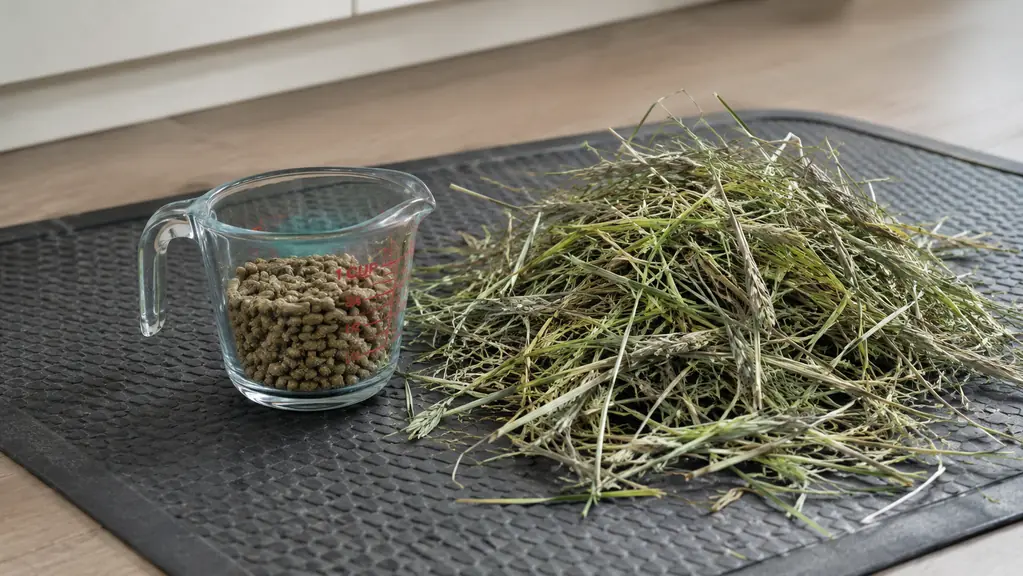
The first bag arrived on a Tuesday afternoon, and I opened it expecting something closer to the colorful bag I had been buying. Instead I got a plain sack that smelled like the hay barn at the feed store, not like fruit. I measured out the recommended serving into a glass cup and laughed at how little it was. That tiny pile was the entire point. It took me a week to stop feeling like I was underfeeding her.
The third thing is the transition. If your rabbit has been eating a sweet mix, expect a week of attitude. Some rabbits adjust in two days. Clover took closer to ten. Stick with it. A healthy rabbit will not starve itself out of spite, although it will absolutely try to convince you it might.
And a rabbit's digestion does not love sudden changes. Going cold turkey from one food to another can cause soft stools while the gut adjusts. That is why the slow blend matters. I mixed old and new for about ten days, and when I noticed any softness, I held the ratio steady for a few extra days before increasing the new food. It is not a medical promise, just the approach that worked here.
What's Actually In the Bag
Oxbow makes several pellet lines, and the Essentials Adult formula is the one built around timothy hay. Timothy is a grass hay, lower in protein and calcium than alfalfa, which matters once a rabbit is past the growing stage. The first ingredient is timothy grass meal, followed by soybean hulls and a short list of plant-based ingredients, with vitamins and minerals added. It is a fixed formula, which means the recipe does not change from bag to bag.
I buy the 5 lb bag, and it lasts Clover a long time because the daily serving is small. I store it in a metal canister with a tight lid, because a half-used paper bag on a shelf goes stale, and the rabbits I have kept before would rather skip a meal than eat stale pellets. A cool, dry spot keeps the smell fresh and the texture consistent.
I also write the opening date on the bottom of the bag with a marker. That sounds fussy, but it tells me how long a bag has been open, and it keeps me from guessing whether the pellets are still fresh. The bag I opened at the start of January still smelled like cut hay when I finished it near the end of March. Stale pellets are the one thing this rabbit will not tolerate.
One honest note about quality control: the bag does contain some pellet dust at the bottom and a few broken pieces. In the year I have been buying it, the food has never been moldy, stale, or off-smelling. But the dust is real, and it is worth knowing before you pour your first serving. I scoop from the top and shake off the fines, and it has not been a problem.
Clover ate every pellet in her bowl for the first time in months during the third week of the switch. That was the moment I stopped expecting her to be a muesli rabbit.
How It Performed Over a Year
After a full year on Oxbow Essentials, here is what I can actually report from my house. Clover eats every pellet in her bowl, which never happened with the mix. Her weight has stayed steady at about four pounds. At her last checkup, the vet described her as being in good condition. I am careful to say good condition rather than promise a health outcome, because pellets are one part of a rabbit's life, not the whole picture.
The picky eating did not vanish entirely. She still has evenings where she sniffs the bowl and walks away, and I have learned to read the difference between 'not hungry' and 'holding out for something better.' The tell is the hay pile. If she is eating hay normally, I do not worry. If the hay is also being ignored, that is when I pay attention.
What surprised me most is the consistency. With the grocery store bags, the color and smell changed noticeably between batches, and Clover would go through phases of refusing the food. Oxbow has looked and smelled the same every single time. That reliability is the reason I stopped shopping around. It is also the reason I recommend the long-term review on this site if you want the full picture of a year of daily feeding.
One more honest note. The pellets are only interesting to Clover for about ten minutes after I fill the bowl. She eats her serving, checks the hay rack, and moves on with her day. That is exactly what I want from a pellet. It is steady, boring nutrition, and the boring part is the feature.
The Tradeoffs Nobody Mentions
Let me be straight about the downsides. The first is the cost. The current price runs higher than the generic pellets at the grocery store, and on a 5 lb bag that adds up. You are paying for the fixed formula and the quality control. Whether that is worth it depends on your budget and on how much your rabbit actually eats, which, for a single small rabbit, is not much.
On the money side, the 5 lb bag lasts long enough that I do not buy it often. For a single four-pound rabbit eating a measured serving, a bag sits in my pantry for months, which softens the difference at the register. I would rather pay more for a fixed formula than save a little on a bag that changes quality and gets refused halfway through. That refusal happened with two different generic bags last year, so this is not a hypothetical.
The second tradeoff is the boredom factor. If you enjoy watching your rabbit sort through a colorful mix for the good bits, this pellet will disappoint you. It is plain and uniform and, frankly, a little dull to look at. That is the entire point, but it is worth knowing before you buy a bag and wonder if you made a mistake.
The third tradeoff is that pellets are a small part of rabbit care. This food will not fix a rabbit whose diet is mostly pellets and almost no hay. Hay is what keeps a rabbit's digestion moving and their teeth worn down. If your rabbit refuses hay, changing pellet brands is not the answer, and that is true no matter which food you choose.
The fourth thing I would tell a friend is to measure from the start. I spent months filling a bowl and letting Clover graze, which is not how pellets work for an indoor rabbit. A measuring cup and a set daily serving would have saved me from a chubby phase and from wasting food. The bag lasts longer, the rabbit stays leaner, and the routine gives a picky eater something to rely on.
Alternatives I Considered
Before I settled on Oxbow, I tried two other approaches. The first was the muesli-style mix from the pet store, which Clover loved and which taught me everything I know about selective eating. The second was a generic timothy pellet from a big box store, which was cheaper but changed between bags, and Clover would go through phases of refusing it.
If you are weighing this against Kaytee Supreme, the comparison on this site breaks down the differences in ingredients, serving sizes, and how picky eaters respond to each. The short version from my house is that both are timothy-based, but Oxbow won because of the fixed formula and because Clover actually finishes her bowl. I have kept a bag of Kaytee in the pantry for emergencies, and it is a reasonable backup. It is just not the one I reach for first.
If I could go back to the day I brought Clover home, I would skip the colorful mix entirely and start with a timothy pellet from day one. The mix taught me what selective eating looks like, but it also gave Clover a taste for sweet pieces that made the switch harder than it needed to be. The habit of picking out the good bits took weeks to break.
One more alternative worth naming is simply feeding no pellets at all. Some owners go pellet-free and rely on hay and greens. That can work for the right rabbit, but for Clover it did not. She needs the structure of a small measured serving, and the Oxbow bag gives her that without any guesswork on my part.
What I Liked
- Fixed formula that does not change between bags, which picky rabbits notice
- No colorful pieces, seeds, or fruit, so a selective eater cannot pick out the sugary bits
- Timothy-based with lower protein and calcium, appropriate for adult house rabbits
- The 5 lb bag lasts a long time because the daily serving is small
- Consistent quality and fresh, hay-like smell across every bag I have bought
Where It Falls Short
- Plain and visually boring, which is the point but can be off-putting at first
- Costs more than generic grocery store pellets
- Some pellet dust and broken pieces settle at the bottom of the bag
- Switching from a sweet mix can take a week or two of attitude
Who This Is For
Buy this if you have an adult rabbit who eats hay first and pellets second, and you want a plain, reliable pellet without the candy aisle. It is also a strong fit if your rabbit is a selective eater who picks the sweet pieces out of a mix, because there is nothing to pick out. And if you are tired of buying bags that change quality from one purchase to the next, the consistency alone is worth the switch.
If you are still on a colorful mix, I get it. The bag is cheaper, the bunny on the front is cute, and your rabbit acts like it is the best meal in the world. Just know that the enthusiasm is mostly for the sweet pieces. The switch is a week of attitude and then a lifetime of a cleaner bowl.
Who Should Skip It
Skip it if your rabbit is under a year old, because growing rabbits need the higher protein and calcium of a young rabbit formula rather than an adult one. Skip it if your rabbit refuses hay entirely, because no pellet can replace the role hay plays in digestion and dental health, and that is a conversation to have with your vet. And if your rabbit is thriving on a timothy pellet you already trust, there is no reason to switch. This is a very good food. It is not the only food.
The boring pellet that ended the bowl-tipping protests
If you are ready to make the switch, give it the slow ten-day blend and do not give in to the disappointed stare. It is worth the week of attitude.
Amazon Check Today's Price on Amazon →